In what ways does the aggressive instrumentation embody the "instability" of being hyper-aware yet completely stuck?
When something is aggressive, it’s impossible to ignore. It puts you on alert, and there’s a sense of danger in that. That’s exactly what we wanted the instrumentation to do.
The aggression carries a loss of control. It’s erratic, unpredictable, and constantly shifting, which creates a feeling of instability, like you have to stay switched on just to keep up.
That mirrors the state of being hyper aware but completely stuck: your mind is active, scanning everything, but there’s nowhere to place that energy.
Tez leaned heavily into that by adding unsettling elements throughout the track. There’s a guitar layer that acts like an alarm, ascending and descending at different points.
It never resolves and it feels like movement, but it doesn’t actually take you anywhere.
Stev’s lyrics, and the way the energy builds line by line, add an impending sense that something is coming, as though if you’re not paying attention, something bad will happen.
That tension is intentional.
It reflects the way people move forward and backward in life, feeling pressure from time, from expectation, from the need to “do something,” but often without real direction.
You’re constantly aware of time passing, but that awareness doesn’t mean clarity or ease. It doesn mean more pressure though.
We lean into the absurdity and creepiness of that. Even the things that are meant to feel “normal” or “positive” become unsettling when you really look at them.
There’s a kind of forced surface level positivity that, when left unquestioned, starts to feel hollow and uncomfortable.
We’re drawn to brutal honesty, because at least it’s honest. It doesn’t pretend.
The instrumentation becomes confrontational in that context. It’s a response to that pressure, and to the discomfort of how rarely things are examined beneath the surface.
We don’t respond well to environments where that kind of surface level engagement dominates. It creates a kind of dissonance, where things are presented as fine, or normal, but don’t feel fully interrogated or honest. It feels like a horror movie.
In some places and social environments more than others, that disconnect feels more present. It contributes to a heavier, harder to name atmosphere, that creates a terrible sense of unease beneath the surface of everyday life and communication.
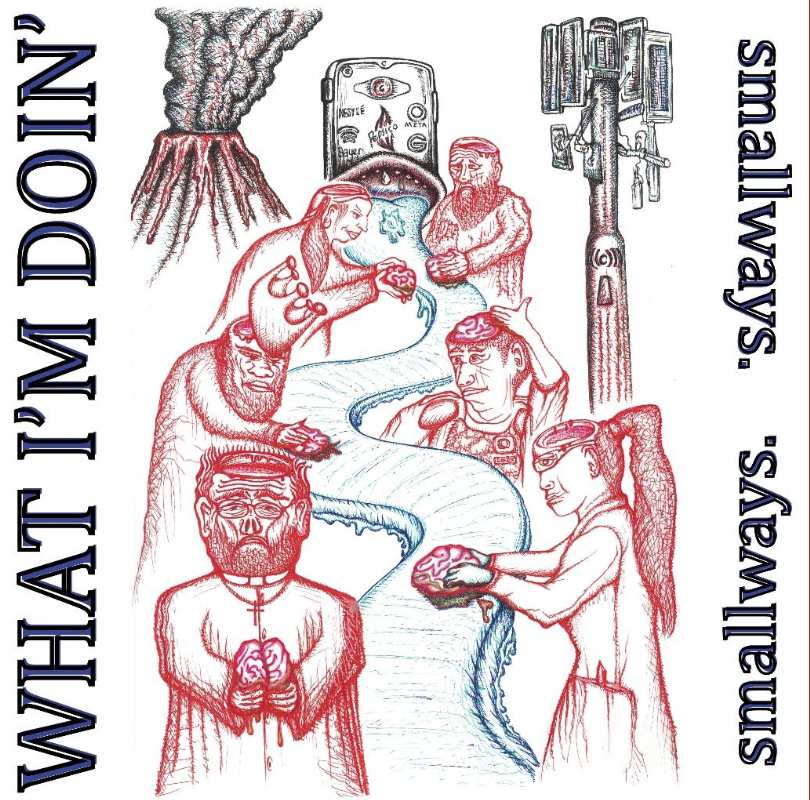
WHAT I'M DOIN' is alarm-like, and it's intense. It doesn’t let you sit comfortably, it forces the same question onto the listener: What are we actually doing? Does anyone really know?
You mentioned that hierarchy is often mistaken for order; how does the music critique the "visible chaos and exploitation" you see in the world?
The lyrics are very direct in expressing the consequences of a world that ignores visible chaos and exploitation, particularly when shaped by hierarchy and centralised systems of power.
There’s also a strong layer of sarcasm running through it, where we’re portraying a familiar type of person: someone emotionally detached from their actions, their impact, and even their own trajectory. They avoid reflection, avoid accountability, and let things deteriorate, often in ways that inevitably affect the people around them.
It’s a kind of detachment that gets framed as freedom, but it isn’t neutral. It raises an interesting contradiction in how it’s perceived socially, where certain traits are often celebrated when tied to success or stability, but judged very differently when someone is without resources or security.
The song is essentially pointing to what happens when that reality is left unacknowledged and how people and communities begin to collapse under systems that don’t fully account for them.
Rather than treating it as an abstract critique, the lyrics try to name that pattern in real time. That act of naming is important to us, it’s the first step toward collective awareness.
The intention isn’t to provide answers, but to highlight something that is already widely experienced but not always articulated.
Lines like “I don’t even care” sit in that space of sarcasm and emotional bluntness, reflecting a kind of learned detachment, where larger realities are ignored as long as immediate comfort is maintained. The song questions what that detachment costs, particularly for those who exist outside of that comfort.
We're not assigning blame, we're exposing a repeating pattern that systems tend to reproduce themselves, and without reflection, human consequences become background noise.
If humans are becoming background noise, who is any of this for? Who are performing for? Who are we wearing a mask for? The song is trying to bring that noise back into focus. Humans back into focus.
There are a few layers to this song, as with all of our releases. It’s both personal and observational in our internal experience combined with direct observation of the external world.
Together, they form the kind of documentation that becomes our music and our art itself.
Why was it important for the band to not separate yourselves from the systems you are critiquing?
It wasn’t a deliberate decision so much as something that felt organic. We’re in the system, we’re human, and we’re experiencing it, as anyone else alive is. So when we talk about it, we’re not positioning ourselves outside of it. We’re part of it. That’s the point.
We have the willingness to explore the parts of life that don’t make sense to us, rather than avoiding them, because we see that avoidance as part of why people continue to struggle, why gaps exist, and why people fall through them.
We’re not trying to place ourselves above it as observers. We’re asking the same questions from within it: if people are struggling, doesn’t that matter?
If there are shared, visible experiences of difficulty linked to how systems operate, why is it often treated as something negative to talk about?
As Bruce Lee said, “don’t wish for an easy life, wish for the strength to deal with a hard one.”
That idea resonates with us, because engaging honestly with difficulty feels more constructive than ignoring it. We will not ignore the harshness, or darkness of life. It is essential to appreciate, and further connect with the light.
How does the transition from PART 1: MIND YOUR HEAD to PART 2: BROKE BRAIN document the psychological toll of awareness without change?
The transition from MIND YOUR HEAD to BROKE BRAIN maps what happens after awareness sets in.
Part 1: MIND YOUR HEAD is confrontational, but it still holds a sense of clarity.
It’s about recognising systems, patterns, ego, and behaviour, with an underlying belief that awareness can create agency and change. It says: look at what’s shaping you, are you aware too? In a way, it’s still searching for connection and understanding.
Part 2: BROKE BRAIN sits in what comes after that.
It asks what happens when awareness doesn’t actually change anything, and when people don’t seem to respond to or recognise what you’re experiencing.
That’s where the psychological toll begins, and things start to shift quickly.
Instead of awareness leading to resolution, it starts to create pressure.
You become more aware of repetition, misalignment, the systems you’re participating in, and the parts of yourself you didn’t consciously choose to develop. All the while, you still have to function within that same structure.
In fact, people often expect you to succeed within systems you’re already aware are harmful. Those expectations are framed as normal because they’re accepted as the terms and conditions of life, collectively, without thought or questioning.
If you don’t meet those expectations, you’re labelled as lazy, unproductive, or as if something is wrong with you. When in reality, resistance can be a deeply healthy and human response to something recognised and experienced as unsustainable.
You’ve stated the song doesn't attempt to resolve; how do you hope the audience responds to the question, "Where’s your head in all of this?"
We hope it challenges them. We hope it leads to deeper reflection and realisation.
Ideally, it encourages people to become more aware of others who are struggling, and to engage with that more directly rather than overlooking it, minimising it, or treating it as something outside their responsibility or capacity to respond to.
There are also harder questions underneath that about how systems distribute comfort, stability, and pressure differently across people, and what we choose to notice or ignore about that in everyday life. We’re asking people to sit with discomfort, and to hold space for it. There’s value in that kind of engagement, and we’re suggesting it may lead to more sustainable ways of moving forward, if we’re willing to face what’s difficult together, rather than individually.
At its core, it’s about attention to what we choose to see, and what we choose to ignore, and how that shapes the world we’re all part of, how we perceive reality and how we respond.
Ultimately, it’s open ended, allowing space for critical thought rather than a fixed answer.
How do you feel your music provides validation for a community of people struggling with these same feelings of disconnection and misalignment?
We don't really approach music in that way, as in there isn't a real intention to provide validation, but we are aware that some people connect to our music and art in that way.
A lot of the music we make comes from documenting experiences of disconnection, pressure, internal and external contradictions as we live it. If someone hears it and recognises themselves in that, the connection is there, and it's not something we're placing onto it, it's something those people are finding themselves within our music and art.
If anything, our music creates a space where those feelings aren't being avoided or deflected, they're said and felt for what they are and that can be relieving, just like we experience with some of our favorite lyricists, bands and artists. At the end of the day though, we see it as more of a shared recognition and conversation, than any kind of validation.
We're not outside of it looking in, we're right in it. Whatever is being reflected back to people is something we’re also receiving ourselves.